The stain showed up in August, grew after a few afternoon storms, and then dried out by October. Now it is easy to ignore until next summer.
That is the pattern of most leaks here: water gets in only when the rain is hard, wind-driven and daily. Good roof leak repair Tampa homeowners can trust finds the entry point, which is often several feet from the stain, and fixes that. At Roof Repair Tampa FL, whether it is a cracked vent boot, lifted flashing or a slipped tile, the leak gets repaired at its source.
Why Homeowners Call Our Team for Residential Roof Leak Repair
A ceiling stain tells you where water landed, not where it got in. Water runs along the underside of the deck, down rafters and across insulation before it shows. Reliable residential roof leak repair starts with tracing that path.
Our roof leak repair service works from the inside out:
- Attic first. We look for staining on the deck, wet insulation and the high point of the water trail.
- Roof second. We check the matching area on the roof for the usual suspects: flashing, vent boots, valleys, fasteners, and cracked or slipped tiles.
- Photos of both. You see the entry point and the damage, so the repair scope makes sense.
- Repair at the source. We replace the failed part, not just smear sealant over it.
- A check of what got wet. If water reached the decking or insulation, we tell you what needs to be replaced and what will dry.
This is roof leak detection done by a roofer who also does the repair. You are not paying one company to find the leak and another to fix it.
Why an Emergency Roof Leak Repair Cannot Wait for Dry Weather
Leaks in Tampa's climate rarely fix themselves, and the calendar works against waiting. The 1991 to 2020 normals at the airport station put June at 7.37 inches of rain, July at 7.75 and August at 9.03. June through September carries about 61 percent of a normal year's rain.
That means a leak that starts in June can get wet dozens of times before fall. Each soaking softens decking, stains drywall and feeds mold in the attic. Leaking roof water damage spreads quietly behind ceilings long before it drips into a room.
If you have a roof leak and another storm is expected, call a roofing company before the rain rather than after. The priority is to stop more water getting in, even with a temporary cover, then plan the permanent repair once the roof is dry. Emergency residential roof leak repair is about protecting the house first.
There is also the insurance clock. Under current Florida law, notice of a new property claim generally has to be given within one year of the date of loss. Confirm the deadline in your policy, because these rules have changed.
Proof You Can Check: How a Leak Repair Should Be Done
We do not post reviews or badges. Here is what you can check for yourself, about us or anyone else you call.
- Licensing. Florida licenses roofing contractors under Chapter 489. Look up any contractor at MyFloridaLicense.com before they go on your roof.
- Permits. Inside city limits, the city has listed roof covering repairs of 500 square feet or less as not needing a building permit, while noting the guidance can change. Most leak repairs are small, but a leak that has rotted a large deck area may turn into permitted work. We tell you which before starting.
- The 25 percent rule. If leak damage forces work on 25 percent or more of a roof section, Florida's 25 percent rule and its 2007 code exception decide how much of the roof must meet current code.
- Evidence. A real leak repair comes with photos of the entry point before and after. If a contractor cannot show you where the water got in, ask how they know they fixed it.
The Rainy-Season Stain That Dries Out: Dating Your Leak
Here is a situation that plays out every fall in Tampa. A homeowner noticed a brown ring on the ceiling during the summer storms. It stopped growing once the rain eased, the drywall dried, and nothing looked urgent.
Two things make that leak a bigger job the longer it sits. First, a dried stain does not mean a dry roof.
The entry point is still open and will take water again next June, when the rainy season returns. The wood around it has already been wet many times.
Second, the date matters. Florida's current claim notice rule runs from the date of loss, not the date you call a roofer. If the leak came from a covered event, such as a specific windstorm, the first time you saw the stain is evidence you will want.
What to do now, even if the ceiling looks fine:
- Photograph the stain with your phone, which records the date.
- Note any storm that came before it, from your memory or local news.
- Check the attic above it with a flashlight for dark wood or wet insulation.
- Have the entry point found and photographed before the next rainy season.
- Talk to your agent about whether the damage is a covered loss, before the notice period runs out.
Commercial owners face the same problem at larger scale. On a low-slope roof, a leak that appears over one tenant space may come from a seam or drain many feet away. Sometimes a commercial roof leak points toward replacement of that roof section rather than another patch, and we show you the evidence either way.
If the dried stain turns out to be one of many entry points on an older roof, our roof replacement planning starts from the same inspection.
Emergency Roof Tarping and Flashing Leaks
Some leaks need to be stopped today and fixed later. During Hurricane Milton, the airport station recorded 11.43 inches of rain in one day, its second-highest daily total on record, according to the National Weather Service. Rain like that finds any opening in a roof within hours.
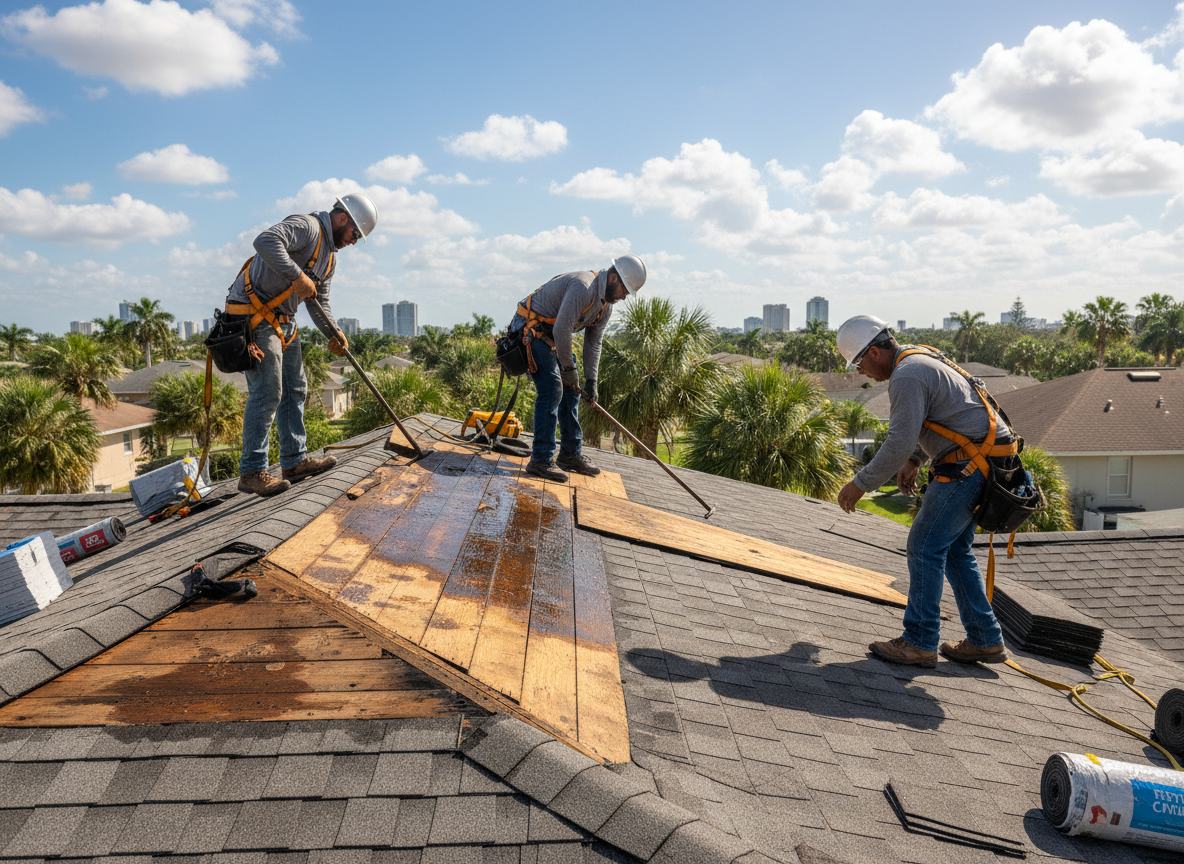
Emergency roof tarping covers an opening or damaged area with a secured tarp so no more water gets in. It is temporary.
A tarp buys time until the roof is dry and the permanent repair is scheduled. The same goes for commercial roofs after storm damage, where the job is to tarp and secure the opening so inventory and tenants are protected while a proper fix is planned.
Flashing leaks are the other common emergency. Flashing is the metal that seals where the roof meets walls, chimneys, skylights and other roof penetrations. When it lifts or its sealant cracks, wind-driven rain gets behind it.
How we handle an urgent leak:
- Ask what you can see and where water is entering the room.
- Cover the entry area with a secured tarp if the roof cannot be repaired safely that day.
- Photograph the damage under the tarp for your records.
- Return when conditions allow to repair or replace the failed flashing, boot or covering.
- Remove the tarp and photograph the finished repair.
Where Roof Leaks Usually Start
Roof Flashing
Flashing is the metal that seals transitions: where a roof meets a wall, around chimneys and skylights, and along the edges. It is a frequent source of leaks because it bridges two surfaces that move differently in heat and wind.
The commercial value of fixing flashing correctly is that it often solves a leak without touching the rest of the roof. A flashing inspection supports the decision between resealing, refastening, or replacing a run of flashing, and between repair now or bundling it into a future re-roof.
Look at walls above lower roofs and around chimneys for rust, gaps or old caulk. Your next step is to photograph those spots from a ladder or with a phone zoom and send the pictures when you book.
Plumbing Vent Boots
Vent boots are the rubber or metal collars that seal around plumbing pipes coming through the roof. Rubber boots crack in strong sun, and once the collar splits, every heavy rain sends water straight down the pipe.
Their value is how small the fix can be. A cracked boot can be replaced in a short visit, which is why it is the first thing we check above a bathroom or kitchen stain. Finding it supports the decision to repair one boot or replace all boots of the same age at once.
From the ground, look at the pipes on your roof with binoculars or a phone zoom. If the collar looks cracked or lifted, book an inspection. Do not climb up to seal it yourself.
Tile Roof Underlayment
On a concrete or clay tile roof, the tiles shed most of the water, but the underlayment beneath them keeps the house dry. Tile roof leak repair often means the tiles are fine while the underlayment under them has aged out.
The value of diagnosing this correctly is avoiding a cycle of replacing cracked tiles while the real problem stays. A proper inspection lifts tiles at the leak area to see the underlayment directly. That supports a decision between a localized underlayment repair and a larger project, which may fall under the 25 percent rule.
If your tile roof is leaking in several places, find your original roof permit date. Then share it with whoever inspects, because it changes the repair options.
Shingle Field and Valley Leaks
A valley is the channel where two roof slopes meet. It carries more water than any other part of the roof, so worn shingles, debris build-up or poor installation there show up fast as leaks. In the open field of a shingle roof, leaks come from lifted or creased shingles, exposed nails, and missing granules that leave the mat to weather.
The commercial value of repairing a shingle roof leak at the source is that one damaged area rarely means a whole new roof. Finding the entry point supports a repair-or-replace decision based on evidence.
Your immediate action: check valleys for packed leaves and pine needles after storms. If debris is building up, schedule gutter and roof edge cleaning before the next rainy stretch.
Book a Roof Leak Inspection
Tell us where the stain is and when you first saw it. We will trace the leak from the attic to the roof, photograph the entry point and any damage, tarp if needed, and give you a written repair scope with photos you can keep for your records or your insurer.
If storm damage caused more than a leak, see our storm and roof repair service.
Call Roof Repair Tampa FL at (813) 547-8189, or visit us at 13301 Arbor Pointe Cir, Tampa, FL 33617.