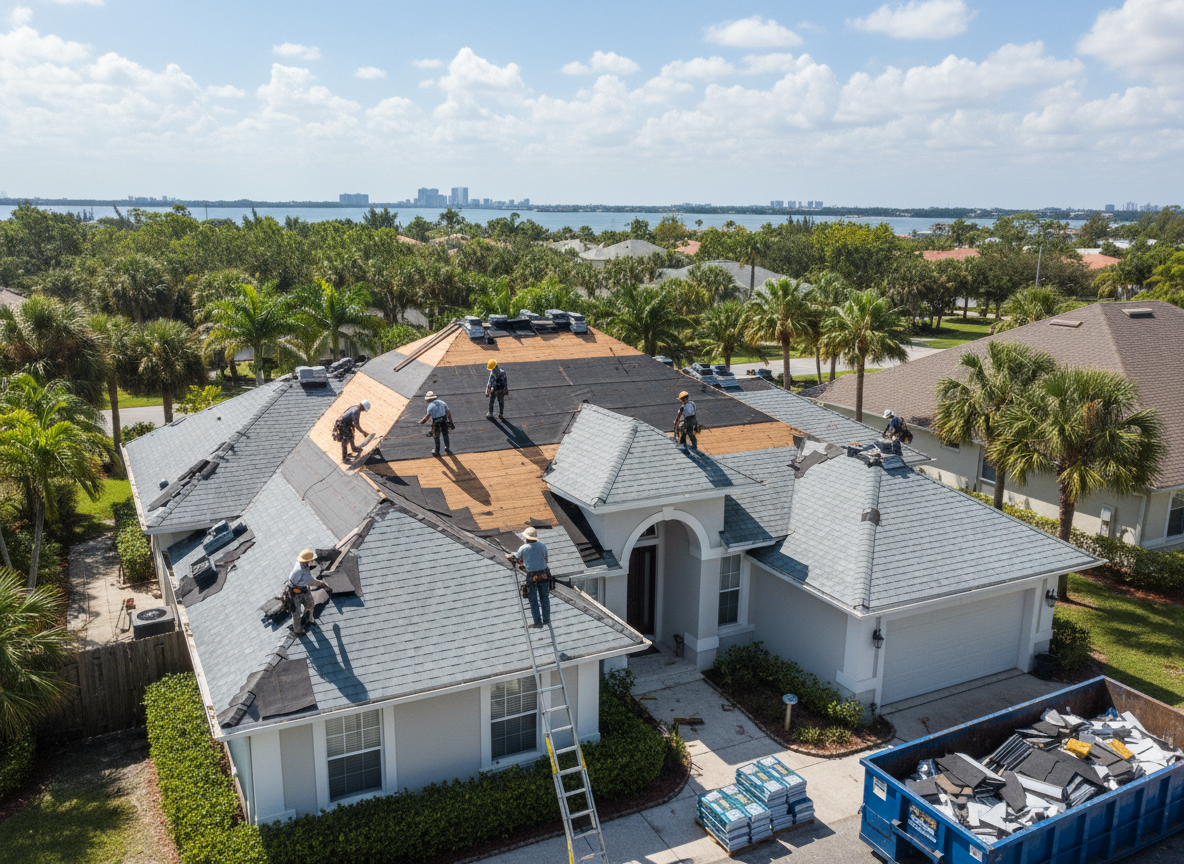
Your renewal letter mentions the roof's age, and now an inspection report decides whether you keep your policy. That is when many homeowners start shopping for a new roof, usually in a hurry.
A roof replacement Tampa homeowners can rely on is built to the current Florida Building Code, permitted and inspected, and documented well enough to answer the next insurer, inspector or buyer. At Roof Repair Tampa FL, we plan the roof and the paperwork together, whether it is a re-roof or a residential roof installation on an addition.
Why Homeowners Choose Our Team for Residential Roof Replacement
Any roofing replacement crew can tear off old shingles. What separates a good re-roof in Florida is what happens between tear-off and final inspection, and what you are left holding afterward.
Our roof replacement services are planned around three outcomes:
- A roof built to the code in effect. The 8th Edition Florida Building Code took effect on December 31, 2023. Your permit is reviewed under the edition in force when it is filed.
- Inspections passed, not skipped. Re-roofs are permitted. In unincorporated Hillsborough County, the process includes a Progress Check inspection of roof attachments before the final.
- Records you can hand over. You get the permit number, inspection results, product information, and photos of the deck and underlayment before they are covered.
We also tell you plainly when you do not need a new roof yet. If a repair will carry a sound roof for several more years, we say so and point you to our roof repair service instead. A replacement should be a decision, not a sales outcome.
Why Planning a Roof Replacement Early Beats Waiting
Roof replacements in this region are driven by the calendar. The Atlantic hurricane season runs June 1 through November 30, and the rainy season, by the National Weather Service definition, runs June through September.
When a storm hits, demand for crews, permits and materials rises all at once. Planning outside that rush gives you more control over scheduling and inspections.
Age matters too. Census data puts the median year built for homes in ZIP 33617 at 1979, and across Hillsborough County at 1990. Many of these homes are on their second or third roof, and a roof nearing the end of its service life is more likely to fail in the first strong storm.
There is also an insurance reason to act before a deadline, not after. If an insurer asks for a roof inspection or replacement as a condition of renewal, you want time to get an inspection, compare options and schedule the work properly.
Proof You Can Check: The Code Behind Your New Roof
We do not have star ratings to show you. What we can show you is the public standard every Florida re-roof is measured against, so you can hold any contractor to it, including us.
- Secondary water barrier and deck attachment. Section 553.844 of the Florida Statutes requires re-roofs to include secondary water barrier and roof deck attachment techniques set by the Florida Building Code.
- Roof-to-wall connections. For higher-value homes in the wind-borne debris region, the same statute calls for roof-to-wall connection improvements on re-roofs, within limits the statute sets.
- Wind design. The current code uses ASCE 7-22 wind maps. On the Risk Category II map, the 140 mph design wind speed line passes through the Tampa area, close to ZIP 33617, so we confirm the exact value for your address at permit.
- Underlayment standards. Under the 8th Edition, synthetic underlayments must comply with ASTM D8257.
- Product approval. Florida requires statewide product approval for roofing products, searchable at floridabuilding.org.
- Licensing. Look up any roofing contractor at MyFloridaLicense.com before signing.
Your Roof Just Turned 15 and Your Insurer Is Asking: Replace or Inspect?
This is the situation most re-roof calls actually start with. A shingle roof installed around 2010 is now past 15 years, and a renewal notice or an underwriting letter raises the roof's age.
Here is how current Florida law frames it, in plain terms. Under section 627.7011, an insurer may not refuse to write or renew a homeowner's policy solely because the roof is less than 15 years old.
For a roof at least 15 years old, the insurer must allow you to have the roof inspected by an authorized inspector, paid for by you, before requiring replacement. If that inspection shows five years or more of useful life remaining, the insurer may not refuse coverage solely because of the roof's age.
A licensed roofing contractor is one of the authorized inspector types, provided the insurer approves them. So the first step is often an honest inspection, not a new roof.
Older homes add a second layer. Citizens Property Insurance requires a four-point inspection on property owner, dwelling and mobile home applications for homes more than 20 years old. Shingle roofs past 25 years, and tile or metal roofs past 50 years, need documentation of remaining useful life.
If the inspection says the roof is done, replace it in a way that pays back. Florida law requires insurers to offer credits or discounts for qualifying wind mitigation features, such as roof deck attachment, roof-to-wall connections and secondary water resistance. The uniform mitigation inspection form, OIR-B1-1802, was revised in April 2026, and Citizens requires the new edition for inspections from April 1, 2026.
We document what your new roof includes for your mitigation inspector. The amount of any credit depends on your carrier and policy, so we never promise a number. These rules are amended often, so confirm the current details with your agent before you decide.
Roof Installation and New Roofs: How the Job Runs
Residential roof installation is where most of the risk in a new roof hides. It is the part you never see again once it is covered: decking, fasteners, underlayment and edge metal.
In Tampa, a new roof installation on an existing home is a re-roof, and it follows the permit and inspection steps above. A new roof on an addition or new construction is designed with the house. Either way, installation quality decides how the roof performs in wind.
Our installation process:
- Inspection and measurements. We photograph every slope, the attic, and the deck where visible.
- Permit. We file with the correct office for your address, city or county.
- Tear-off to the deck. We remove old layers, then inspect and replace damaged decking.
- Re-nailing and dry-in. We secure the deck to code and install the secondary water barrier and underlayment.
- Progress Check or mitigation documentation. Where the county requires it, the inspection happens before the roof covering goes on.
- Roof covering and flashing. Shingle, metal or tile, with new drip edge, flashing and vents.
- Final inspection and handover. You receive the permit record and photos.
We also handle professional roof installation on low-slope sections, including EPDM and TPO membranes on porches, additions and small commercial buildings.
Roofing Materials for a Florida Re-Roof
Shingle Roof Replacement
Architectural asphalt shingles are the most common choice for shingle roof replacement in Florida. An industry estimate puts asphalt at about 65 percent of roofs statewide. A shingle roof is made of the shingles, their adhesive seal strips, starter courses at the edges, and the underlayment beneath.
Their value is years of protection for a modest scope of work, and they install quickly, which shortens the time a home is open. They support a decision between a simpler roof now and a longer-life material later, without changing the roof structure.
Ask any contractor which wind rating the shingle carries and how many nails per shingle the installation uses. Your immediate action is to ask for the product's Florida product approval number in writing with your estimate.
Metal Roof Replacement
Metal roofs come as exposed-fastener panels or standing seam, where the fasteners are hidden under raised seams. For homeowners searching for a metal roof, the difference matters. Standing seam is the larger investment, while exposed screws need periodic attention.
The value is service life and wind performance when the panels, clips and trim are installed to the approved system. Metal also reflects more sun than dark shingles, which some owners weigh against the larger upfront investment.
A metal roof replacement supports a long-term decision: buy once, maintain lightly. Before choosing, ask whether the system is approved for your design wind speed and how it attaches to the deck. Then request the installation details for the specific panel profile you are being quoted.
Tile Roof Replacement
Tile roofs use concrete or clay tiles over an underlayment system. The tile protects the underlayment from sun and impact, and the underlayment is the real waterproofing layer. Many older tile roofs fail at the underlayment while the tile itself still looks fine.
The value is longevity and appearance, with the option, in some cases, of reusing sound tile over new underlayment. Tile is heavy, so the structure has to be checked.
A tile roof replacement supports a decision between a full tile-for-tile system and a lighter material. If you are weighing it, check the age of your current underlayment first. Your next step is to find your original permit date, which also tells you how the 25 percent rule applies to future repairs.
Secondary Water Barrier and Underlayment
The secondary water barrier is the layer that keeps water out if the roof covering is damaged or blown off. Florida requires re-roofs to include secondary water barrier techniques. Common methods are a self-adhered membrane over the deck or seams, or approved underlayment systems.
The value shows up on the worst day: shingles can lift in a storm while the barrier keeps the house dry. It is also a feature recognized on the uniform mitigation inspection form, which can matter for insurance.
This layer supports outcomes on two fronts, storm performance and mitigation documentation. Ask your contractor exactly which barrier method and product they will use. Then ask for a photo of it installed before the roof covering goes on.
Get a Written Roof Replacement Estimate
Book an inspection and you get photos of every slope, a check of your current roof's permit history, an itemized scope covering tear-off, decking, secondary water barrier and roof covering, and an honest answer on whether repair or replacement makes more sense.
If you have an active leak right now, start with our roof leak repair service. If you are replacing the roof, a pre-installation gutter cleaning keeps the new drip edge draining properly.
Call Roof Repair Tampa FL at (813) 547-8189, or visit us at 13301 Arbor Pointe Cir, Tampa, FL 33617.
Roof Replacement Services We Offer
✓Roof Installation
New roof installation on existing homes, additions and low-slope sections: tear-off to the deck, deck re-nailing and secondary water barrier to the current Florida Building Code, permit and inspections handled, and photos of the work before it is covered.